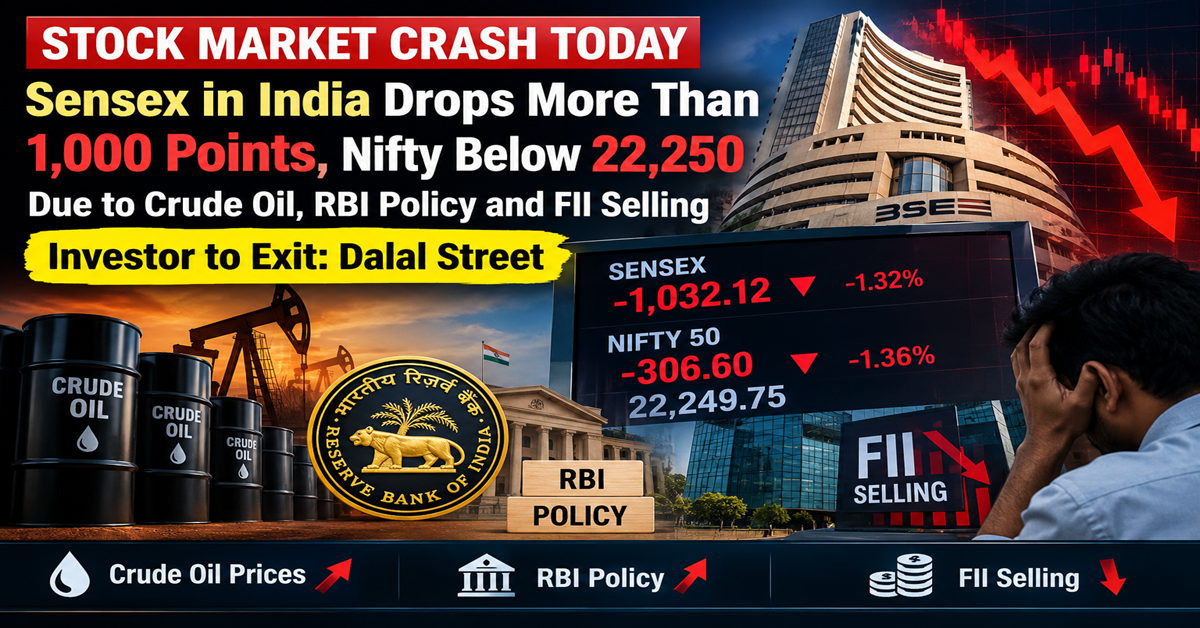
Indian Share Market Today: The Indian Equity markets suffered heavy selling pressure on Thursday, October 8, 2026, owing to the rising crude oil prices, concerns over interest rates, foreign fund outflows, weakening rupee and negative cues from other Asian and European markets.
The selling gathered pace during the trade, dragging the Sensex and the Nifty 50 down sharply. The Nifty 50 was near the 22,200 level, and the Sensex was down more than 1,000 points in the day’s trade.
Selling was pan-India with mid-cap and small-cap indices also seeing heavy blows. Meanwhile, India VIX, an indicator of market’s future volatility, also headed north, signaling nervousness among traders.
Sensex and Nifty Today
The benchmark indices opened on a weak note and as the day progressed, the losses added up.
During the afternoon session, the Sensex dropped more than 1,150 points at one point, while the Nifty 50 index slipped to around 22,200 levels. Market breadth was extremely negative with a large number of stocks trading below their previous close.
Later in the trading session, the Nifty 50 traded at around 22,241.80 points, falling by nearly 1.60 per cent, whereas Sensex traded around 71,587 points, falling by nearly 1.45 per cent during a Moneycontrol market update.
The pain was not restricted to large-cap stocks. The Nifty Midcap 150 and Nifty Smallcap 100 fell over 2%, indicating this was also not limited to the main indices.
Reasons Why the Indian Stock Market is Falling Today?
There were a few factors that aligned to put India under the pump.
1. RBI’s More Hawkish Policy Stance
A significant fact was the decision of the Reserve Bank of India on its monetary policy.
It increased its benchmark repo rate by 25 basis points to 5.5% and shifted to a more tightening bias in its statement. This pushed expectations of higher interest rates for longer.
The other side of the coin for higher interest rates is what it does to business. For its part, borrowing becomes pricier so the rate-sensitive pockets of the economy – banks, autos, property and others – could take a hit.
Investors are also changing their valuation assumptions because they can also make bonds and other fixed income products look more attractive.
2. Crude Oil Prices Above $100
The other big concern for India is the escalation in crude oil prices.
International oil prices went up to a level of more than USD 100 a barrel on fears of oil supply disruption and geostability concerns.
Crude oil demand by India accounts for a considerable part of the total crude oil requirement. Consequently, a persistent increase in crude prices can pose a risk to India’s import bill and to inflation and the current account.
The operating costs of a business will also rise due to higher fuel and transportation expenses.
3. Significant FII Liquidation
FIIs or Foreign Institutional Investors Continue To Keep Indian Equities Under Pressure.
Foreign outflows were already quite significant. According to Reuters, investors had sold a net 469.9bn over the last nine sessions, and the year-to-date outflows had been the highest on record.
Selling by foreign investors is one of the factors that can boost market volatility when they decrease their holdings in Indian stocks.
4. Weak Rupee
The Indian Rupees also depreciated versus the US dollar.
Market sources said the rupee closed at around 96.75 per US dollar against previous close of 96.35.
Lower rupee: An even weaker rupee tends to push up the cost of imported goods such as crude oil and could impose additional inflationary pressure on India when investors are already worried about higher oil prices.
5. Increasing Global Bond Yields
B. Bond yields- global equity markets are taking bond yields seriously as well.
US Treasury yields tend to help draw fund flows from global investors to the comparatively safe fixed-income assets, especially when equity market valuations are high.
The impact of this change in foreign flows is being felt on the domestic front and emerging markets like India too. There was a risk of global equity weakness and bond yield driven cautiousness prevailing on Dalal Street.
IT Stocks Provide Some Relief
IT was one of the few sectors in the green.
Nifty IT was one of the few sectors that managed to stay in green in the session. Other stocks that held up against the mayhem included Infosys, TCS, Tech Mahindra and HCL Technologies.
“Infosys and TCS definitely stood out for investors looking for something to hide in, with the selling being more intense in other sectors,” said Shah.
But such a number of traditionally strong industry was insufficient to redress the industry.
Metals, Energy and Realty Among the Worst Hit
The selling was especially brutal in various cyclical groups.
The Nifty Metal index was the among the major sectoral index where the index fell about 3.51%. The indices of Realty, energy, oil and gas, infra, media stocks also witnessed sharp plung.
One aspect that makes weakness in metals very interesting is the fact that commodity-related stocks are quite sensitive to revisions in global growth expectations and risk appetite.
Like other types of stocks, markets for real estate companies can be affected by rates because increased borrowing costs can influence demand for homes and financial conditions.
Adani Enterprises Among Top Losers In Nifty
Individual stocks also experienced significant pressure.
Share Price Adani Enterprises declined by almost 7% during the session while ITC, JSW Steel and Adani Ports were also among the top losers noted during trade.
Other notable declines included Max Healthcare, Apollo Hospitals, IndiGo and Tata Motors.
The massive losses reveal that the day’s weakness was not isolated to one individual firm or industry.
India VIX Rises as Volatility Increases
An important metric to monitor when the market is on a downslide is India VIX.
As per the Moneycontrol update, the India VIX rose over 10% to approximately 15.33.
A high VIX suggests that traders expect higher volatility in the near future.
This means that intraday and options traders might experience quicker price movements and more volatility in the premium of options. As a result, traders should be aware of their leverage and position size when volatility rises.
Mid-Cap and Small-Cap Stocks Also Under Pressure
Correction was relatively broad across market cap categories.
The Nifty Midcap 100 lost close to 2.30%. The Nifty Smallcap 100 was down nearly 2.21%.
This is significant as smaller companies tend to have a greater price movement during risk aversion periods.
As investors turn risk averse, these tend to be the first assets to be sold, resulting in a more severe sell off of mid and small caps.
What Does This Mean for Investors?
In this type of market environment investors should not be making buying or selling decisions based on just one day.
While a big drop doesn’t necessarily mean all stocks are cheap, it can. It also opens the door for fundamental businesses to see their valuations get cheaper, too.
Long-term investors may want to focus on:
Strong company balance sheets
Sustainable earnings growth
Reasonable valuations
Small or controllable debt
Solid Cash Flow
Sector fundamentals
Management quality
Before you make any investment decisions, investors must think about their time horizon.
Nifty 50 Technical Levels to Watch
The technical picture has become less bullish following the sharp decline.
The market participants considered the 22,600 as a key level. A clear break below this level could open up the possibility of the index slipping towards the 22,200 level, while recovery above 22,750 – 22,800 zone could boost short term sentiment.