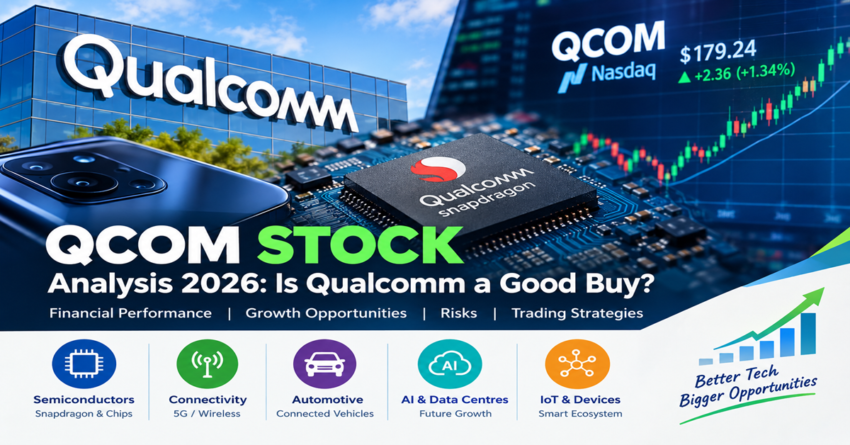
QCOM Stock Analysis – Is Qualcomm Stock a Good Investment? 2026
QCOM Stock is capturing the interest of investors seeking exposure to semiconductors, artificial intelligence (AI), smartphones, automotive computing and the boom in connected devices. Qualcomm Inc. Is a prominent tech player traded on the Nasdaq with its QCOM stock having the symbol. Qualcomm Incorporated is the company’s name and is known for its Snapdragon chipsets, wireless tech and patent licensing business.
Qualcomm is diversifying beyond its traditional smartphone business and expanding into sectors such as automotive, IoT, PCs and AI data centre infrastructure as the semiconductor industry matures.
For investors, the key remains whether Qualcomm will be able to leverage these growth initiatives to generate sustainable revenues, increased profit and long-term value for shareholders.
In this tutorial, we will go through the business model of Qualcomm (QCOM), their latest financial results, future growth prospects and dangers, valuation factors, and some hands-on ways to analyze QCOM stock and choose to invest in it.
About QCOM Stock:
QCOM represents the ticker symbol for Qualcomm Incorporated, a computer technology company based in San Diego, California.
Qualcomm produces semiconductors and wireless technology, computing and services and provides intellectual property licensing and services. Qualcomm supplies to mobile device manufacturers, car manufacturers and more technology companies.
Qualcomm is one of the best known suppliers of smartphone tech with the Snapdragon chipsets that underpin many higher-end Android handsets. The firm also makes money from licensing some of its wireless technology patents to other device makers.
Investors who want to own Qualcomm stock should note that Qualcomm is not only a smartphone chip company. There are different technological segments of the company.
About QCOM stock
- Company: Qualcomm Incorporated
- Stock ticker: QCOM
- Stock exchange: Nasdaq
- Industry: Semiconductors and wireless technology
- Our key products: Snapdragon processors and connectivity chips, car platforms and AI computing products
- Main areas of business: Semiconductor products and technology licensing
Qualcomm’s revenues are influenced by consumption for electronics, semiconductor industry competition, licensing revenue, customer relationships and its capacity to innovate.
How Does Qualcomm Make Money?
Knowing Qualcomm’s business model before we dive into its stock is an important step to take.
Its revenue comes from the sale of chips, licensing of patents, and other strategic technology related operations.
1. Semiconductor Business
Qualcomm’s primary business, Qualcomm CDMA Technologies (QCT), makes and sells chipsets and related software.
Some of these products power automotive, connected, smartphone, and industrial devices.
Semiconductors can benefit from new device launches, processor upgrades or the addition of high-end connectivity and AI capabilities.
But revenue for semiconductors is impacted by the shifting tides of the customer demand, product launches, inventory, and rivalry.
2. Technology Licensing
Qualcomm’s QTL (Qualcomm Technology Licensing) business licenses its intellectual property to companies that incorporate the applicable wireless technology.
It is important because Qualcomm has a large patent portfolio of wireless communication patents.
Licensing revenue may be an alternate source of revenue, apart from selling chips. But, licensing of chips, legal disputes, regulation, and customer discussion can also impact this business.
3. Automotive Technology
Connectivity has evolved, and so have vehicle electronics, such as driver assist, digital instrument clusters, and computing devices.
Qualcomm provides platforms for this application to support it.
With the increased connectivity and software-enabled capabilities of vehicles, automotive technology could be an even bigger contributor to Qualcomm’s business.
4. Internet of Things and Personal Computing
Qualcomm also creates technologies for connected vehicles, the internet of things, networking, wearables, and PCs.
These markets offer possibilities to lower the reliance of the firm on revenues generated through the sale of smartphones.
Of greater concern for investors is whether the contribution from those growth segments will be substantial enough to compensate for declining sales in other, less dynamic segments.
QCOM Stock Financial Performance: What Investors Should Know
Financial results allow investors to see if a company is expanding, breaking even, and has cash coming in.
Qualcomm provided the following results for its third quarter of FY 2026, which ended on 28 June 2026. Qualcomm’s GAAP earnings per share for the quarter were $1.87 and its non-GAAP earnings per share were $2.21.
Revenue was down 4% year on year. The company had lower handset-related revenue, but this was partly offset by higher automotive and IoT revenue.
While these numbers demonstrate Qualcomm’s potential, they also show its risks. The company’s newer lines of business have been expanding, but it still has its roots in the smartphone market.
Financial Measures Worth Looking for
Revenue growth: Compare quarterly and annual revenue to see if the company’s business is increasing.
It shows the amount of profit for every common share. Investors need to separate the GAAP figures from the adjusted, non-GAAP numbers.
Operating margin: This indicates the percentage of revenue that Qualcomm has left over after paying for variable production costs.
Free cash flow: Cash flow enables investors to evaluate if the business has enough free cash flow to finance research, acquisitions, dividends, repurchasing shares, and so on.
Debt and cash balances- used to evaluate financial slack and the company’s capacity to operate in weak economic conditions.
Segment revenue: How are different areas of the business-such as handset, automotive, IoT, and licensing-performing?
Investors would do well to look at more than one quarter when evaluating Qualcomm.
Why Is QCOM Stock Getting Attention in 2026?
This growth in new markets will be another key catalyst in Qualcomm’s investment story.
Day, the company laid out a wider strategy for AI data centres, automotive, industrial and other non-handset-related markets.
Qualcomm increased its fiscal 2029 guidance for non-handset revenue to $40 billion. It also provided guidance of more than $15 billion in data centre revenue and $10 billion in automotive revenue in fiscal 2029.
Those are Qualcomm’s plans for the future, not financial assurances. Investors need to watch as the company meets its goal by introducing its products, gaining new customers, increasing sales, and turning a profit.
Artificial Intelligence and Data Centres
Artificial intelligence is fuelling demand for computing infrastructure, specialized processors, networking hardware and energy efficient hardware.
Qualcomm is looking to grow its foothold into AI infrastructure with its data centre plans, which includes the Qualcomm Dragonwing portfolio.
This business has the potential to generate additional revenue if the company is able to bring forth products that fulfill customer’s demand for performance, power efficiency, and cost.
But dedicated incumbents and specialised chip makers are also targeting the data centre. Investors need to pay attention to real customer traction and earnings rather than solely AI-related assertions.
Automotive Technology
With automotive electronics, manufacturers are developing connected dashboards, driver assistants and increased computing power.
Qualcomm automotivebusiness is invested in this direction for the long term.
Important parameters include auto sales growth, new design wins, production scheduling, and duration between announced projects and actual sales.
Diversification Beyond Smartphones
Revenue from smartphone sales has always played a key part in the company’s success.
Venturing into automotive, IoT, computing and data centre business would broaden the company revenue streams.
Diversification may lessen reliance on one market. But, new enterprises need capital, face competition from incumbent businesses and can take several years before they become viable.
What Factors Can Move QCOM Stock Price?
The share price of Qualcomm can change based on company-specific news as well as general market trends.
Quarterly Earnings Reports
Revenues, earnings, margins and management guidance are reviewed by investors after every earnings report.
Even if a firm reports an accounting profit, if it is below what investors forecasted the share price could fall.