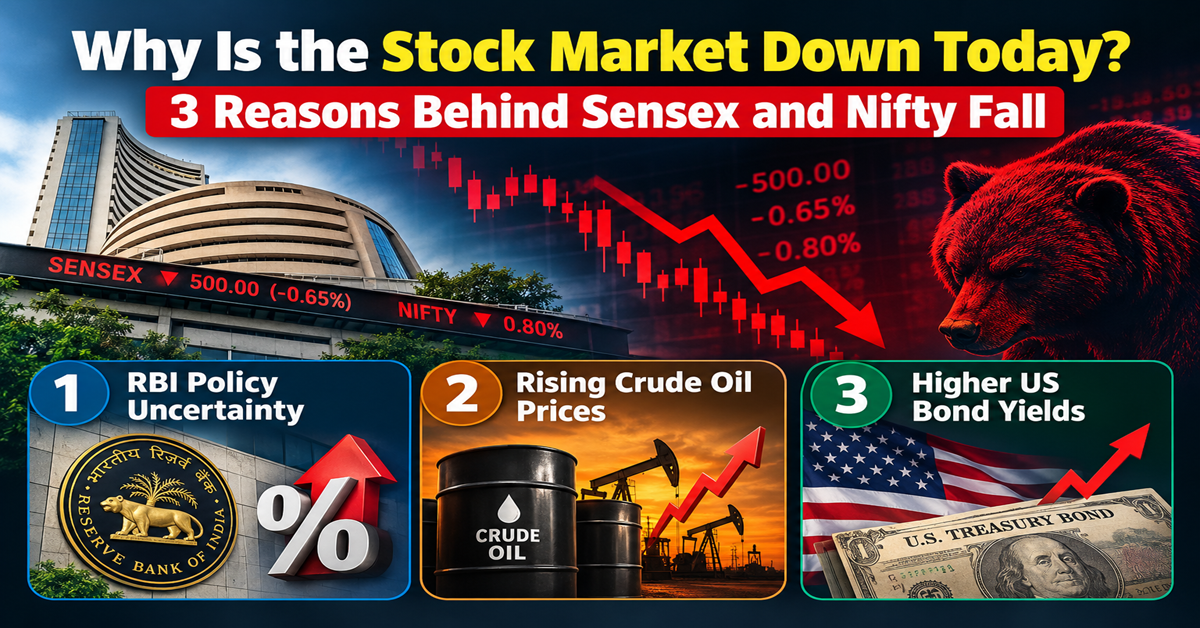
The Indian stock market was under intense selling pressure on Wednesday, October 7, 2026, as investors became cautious ahead of the Reserve Bank of India’s monetary policy announcement.
The Sensex and the Nifty 50 opened sharply lower. The Sensex dropped as much as 500 points and the Nifty 50 was down over 0.8%. HDFC Bank, Titan, ICICI Bank, Reliance Industries and Axis Bank were some of the companies stocks that dragged the indices in the early part of the session.
A single event does not explain the weakness in the markets. What investors are really paying attention to is the combination of uncertainty around domestic monetary policy, increases in crude oil prices and higher US bond yields.
Then why is the stock market dropping today? These are the three biggest things investors are keeping an eye on.
1. RBI Monetary Policy Creates Uncertainty
The most important domestic factor that leads to the volatility of today is the monetary policy of RBI.
Investors were already bracing for a 25-basis-point hike in the repo rate before the policy announcement. It was not a question of whether the RBI would increase rates, but what tone the central bank would set about future rates, inflation, and growth.
Rise of interest rates: If interest rates are increasing and the economy is doing well, it can lead to more expensive borrowing for companies and consumers. This can impact company profitability and investment and make investors more cautious.
Market was looking for clues on RBI from the following:
Future interest-rate decisions
Inflation expectations
Economic growth
Liquidity conditions
The RBI’s future policy direction
Uncertainty prompted a reduction of risk by some traders and investors ahead of the policy.
Why is RBI rate important for stocks?
The stock market is affected by the interest rate, both directly and indirectly.
When rates are low, corporates can avail itself of relatively cheap money. Consumers can borrow money for more consumption.
But rates that are too high could raise borrowing costs. Which could negatively impact firms with high levels of debt, or those that are more reliant on financing.
The bottomline for investors is, markets move not only on RBI action but on RBI expectation.
That accounts for why policy days can lead to large intraday volatility.
2. Rising Crude Oil Prices Add Pressure
The second major concern was the rise in the price of the crude oil.
Brent crude moved higher on the day, holding above the $100 level at time of Tuesday morning market selloff with prices around $102. Of note, Middle East concerns had been one of the catalysts for oil prices.
Expensive crude is a big problem for India, which imports a substantial portion of its crude oil needs.
It adds to costs across the economy when oil is more costly.
Higher crude prices can affect:
Inflation
Transportation costs
Manufacturing expenses
Corporate margins
The country’s import bill
The Indian rupee
This creates a difficult situation for investors.
Prolonged higher oil prices could lead to a sustained rise in inflation. This could affect the central bank’s monetary-policy path and keep interest rates higher for a longer period.
Stocks That Can Feel the Pain from the Oil Price Surge
Varied responses to the crude oil movements by various companies.
Companies that extract oil could see an increase in price, but those that rely on large quantities of fuel or petroleum-based raw materials might experience a rise in expenditures.
Industries like airlines, transportation, chemicals and some manufacturers may therefore face up with prices of crude when they go higher significantly.
Meanwhile, higher oil prices can also be a source of concern for the larger market as they could impact India’s inflationary outlook and economy.
3. US Bond Yields Are Rising
Third is the increase in US Treasury yields.
Meanwhile, US 10-year Treasury yield reached near 5.31%, from around 5.27% in the previous session. It had jumped to multi-year high levels, raising fears among investors worldwide.
And how does the US bond market impact Indian stocks?
Global investors are continuously doing comparison for the potential profit potential from various asset classes and countries.
Higher US Treasury yields tend to make US bonds more appealing as a safe haven relative to more risky assets, such as emerging-market stocks.
This may lead to variations in global capital flow.
Higher US Yields Can Affect Foreign Investment
Investors from overseas also keep a close eye on US rates and US bond yields.
A rise in global funds into dollar assets if investors expect US rates to stay high.
So for a developing economy such as India this puts further pressure on equities and the Rupee.
Stock investors face headwinds for stocks from higher US yields, expensive crude oil and a lack of clarity on Indian interest rates.
Sensex and Nifty Face Selling Pressure
All these factors contributed towards the Indian market opening weakly.
During morning trade, the Sensex declined to around 72,591, falling almost 500 points, or 0.65 per cent, from the previous level. The Nifty 50 declined to around 22,600, falling nearly 0.8 per cent at its intraday low.
Selling was not confined to the Sensex and the Nifty as the midcap and smallcap indices also came under selling pressure.
Top stocks like HDFC Bank, Titan, ICICI Bank, Reliance and Axis Bank was among the early losers.
Reasons to Avoid Investors’ Panic About Falling Markets
There can be significant discomfort with a steep market drop, especially if you’re a short-term trader.
However investors should be aware that stock markets tend to move violently around major economic announcements.
Don’t assume that a drop in the market automatically changes the long-term prospects for all of your investments.
Instead, investors should separate:
Short-term market volatility
from
Long-term changes in business fundamentals.
For investors with a longer term perspective, the key questions are perhaps: are a company’s earnings, debt, position and growth all still robust?
But for the traders, it’s a different story. If you are going to be trading with these forex, you will find that you can be in for a sudden surge in the volatility.
What Should Traders Watch Next?
A post a quick washout in the morning, what should traders look for?
1. RBI Policy Announcement
The RBI’s wording and the decision can spell the difference on whether the market pushes lower or try to come back.
What matters is not only the actual rate decision. It is the comments about inflation, growth and further policy that may matter just as much.
2. Crude Oil Prices
If Brent crude stays over $100 for a long time, investors might still fear inflation and costs for companies.
However, if there is a substantial drop in oil prices, it could ease some burden on the markets.
3. US Treasury Yields
Direction of US 10-year yields is key to global risk appetite.
If the markets continue to rise, pressure could continue to build on EM equities, while a dip could help to lift sentiment.
4. Foreign Investor Activity
Foreign institutional flows are another important indicator.
If overseas investors persist in offloading Indian stocks, the Nifty is likely to stay downbeat.
5. Nifty 50 Support Levels
Traders working on an advanced level should look out for key support and resistance areas on the Nifty 50.
A collapse in the market that turns tail and, in short order, regains the battle signals buying enthusiasm. Conversely, a prolonged dip below major support suggests the seller is still the boss.
Is This a Buying Opportunity?
It varies on the individual investor’s strategies and risk tolerance.